- WhatsApp: +86 13606526028
- Email: contact@utien.com



Liquid and semi liquid products are widely used in sauces, condiments, ready meals, snack combinations, dairy products, and other prepared foods. However, these products present special packaging challenges. Differences in viscosity, unstable filling volume, liquid splashing, product residue in the sealing area, and leakage after sealing can all affect package quality and production efficiency.
Utien Pack develops integrated liquid filling packaging solutions based on thermoforming packaging machines. By combining package forming, accurate filling, product loading, sealing, and cutting within one continuous process, the system helps food manufacturers improve filling accuracy, package integrity, and production stability.
Accurate dosing is one of the most important requirements for liquid and semi liquid food packaging. If the filling volume is too low, the finished product may not meet the declared weight. If the volume is too high, material costs increase and excess liquid may flow into the sealing area.
Product properties can also influence filling performance. Thin liquids flow quickly and may splash during filling. Thick sauces may stick to pipes or filling nozzles, making the dose less stable. Sauces containing particles, spices, oil, or solid ingredients require filling systems that can handle complex product structures without blocking the flow path.
Seal contamination is another common problem. During filling, liquid, oil, sauce, or small food particles may remain on the package edge. This contamination can reduce seal strength and create leakage channels. Packages may appear acceptable after production but leak during conveying, cold storage, transport, or retail handling.
Food manufacturers therefore need more than a separate filling unit. They require an integrated solution that coordinates filling volume, filling position, package depth, sealing pressure, sealing temperature, film movement, and production speed.
A Utien Pack thermoforming packaging machine uses bottom film to form package cavities directly inside the equipment. Products are then filled or loaded into the formed cavities before the top film is sealed and the individual packs are cut.
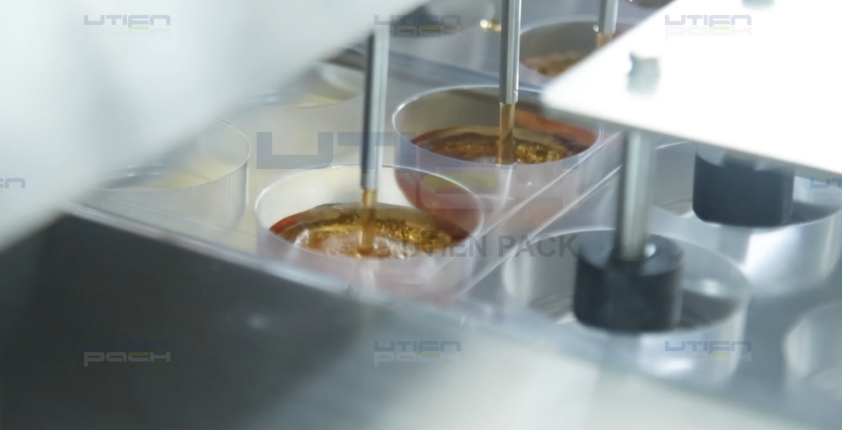
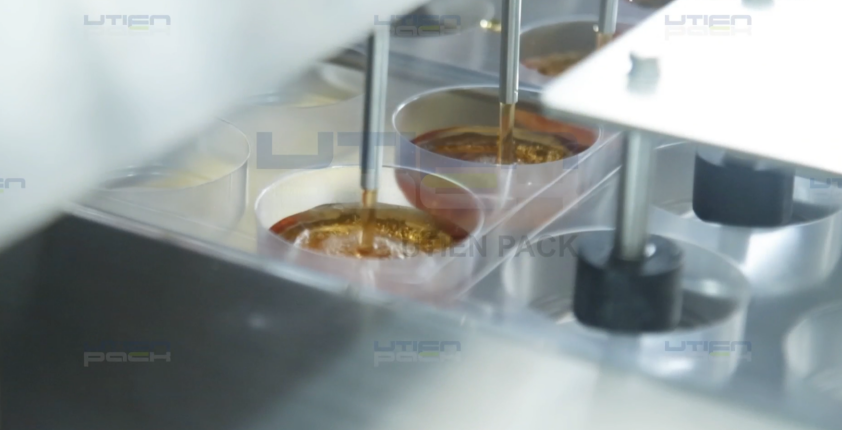
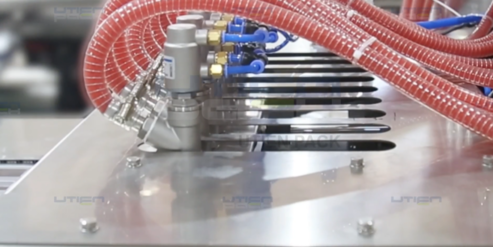
For liquid filling applications, the machine can be equipped with a dedicated filling system and combination module. The filling nozzles, product pipes, filling volume, filling speed, and nozzle movement can be configured according to the viscosity and flow characteristics of the product.
The filling process is synchronized with film transport. Each nozzle is accurately positioned above the corresponding cavity, allowing the product to be deposited in a controlled area. This reduces filling deviation, splashing, and contact with the sealing surface.
Package size and cavity depth can also be customized. A suitable cavity provides enough volume for the food while maintaining a safe distance between the product and the seal edge. This design is especially important for liquids and sauces that may move during film transport.
After filling, the package enters the sealing station. Utien Pack uses powerful and controllable sealing pressure to create a consistent seal between the top and bottom films. Sealing temperature, pressure, and time can be adjusted according to the film structure and product requirements. This helps maintain package integrity even under demanding production conditions.
Sauce packaging is a typical application of thermoforming liquid filling technology. Sauces may vary in viscosity, oil content, temperature, and particle size. Some products flow easily, while others contain spices, minced ingredients, or small food pieces.
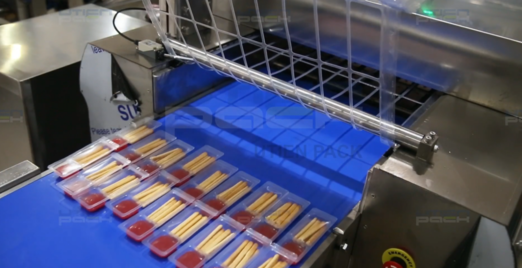
In a sauce packaging project, the thermoforming machine first creates uniform cavities from the bottom film. The filling system then dispenses a measured quantity of sauce into each cavity. Filling volume and speed are controlled to reduce variation between packages.
The nozzle design can be selected according to the sauce properties. For a thin sauce, controlled flow and accurate nozzle closure help prevent dripping. For a thick sauce, a larger flow path can support stable delivery. If the sauce contains particles, the filling structure can be adjusted to reduce blockage and protect the appearance of the ingredients.
Once filling is complete, the package is sealed and cut. The continuous process reduces manual handling and limits the time between filling and sealing. It also helps manufacturers maintain a cleaner production environment and more consistent finished packages.
By continuing to use the site you agree to our privacy policy Terms and Conditions.